👋🏻 Hello!
I'd be very happy to help you on your Nix journey. If you're inspired, intrigued, stuck, or otherwise keen to make some progress, then please do get in contact :)
 by Noon van der Silk
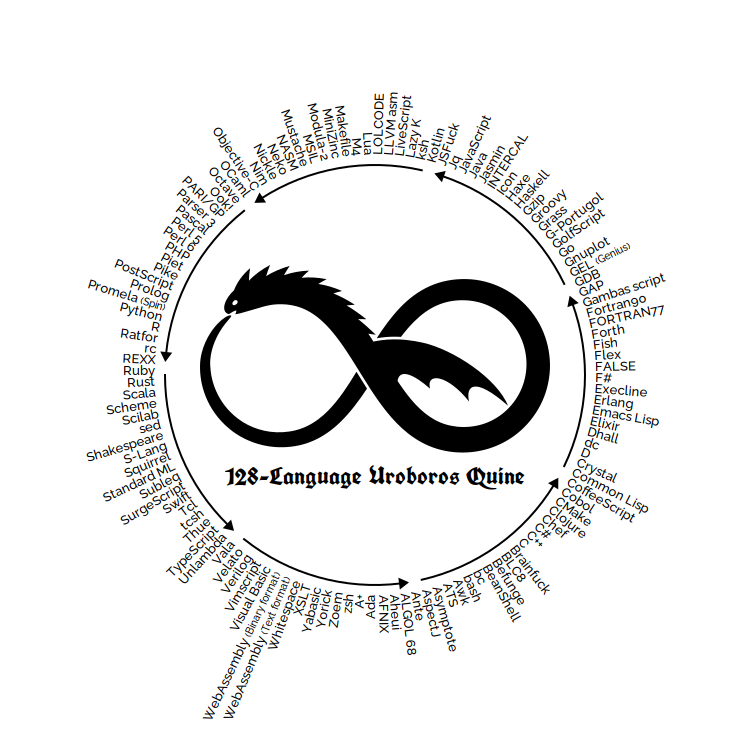 Image credit: @mame's quine-relay project.
The famous quine-relay by @mame project builds a so-called "uroboros" quine through 128 languages; i.e. from ruby to rust to scala to guile to .... all the way back to ruby again, where the final output ruby program is exactly equal to the original ruby program.
Clearly, this is an awesome achievement!
But, have you tried to run it yourself? If you have, you might have found it hard to reproduce. As of the time of writing, the Docker build fails. I don't run Ubuntu, so I can't tell if all the apt-get install commands work; maybe they do, but maybe not.
So, there's a natural idea. Indeed, one that someone else had all the way back in 2021. What if we package it with Nix? Then we can get a simple invocation, nix build ... that will produce the final output.
This seemed like a fun challenge, and a good test for Nix: Would we be able to do it? And if so, at what cost?
Let's get into it.
Even before getting started, we know the answer to this: Yes. The premise of including a particular language is that it should either be available in Ubuntu, or otherwise expressible as a simple ruby program.
So that's simple: it can definitely be done. If it can be built for Ubuntu, we can either see if it's already on nixpkgs, and if not, work out how to build it from source.
Motivation high; it's now down to our willingness to do a bunch of hacking. Let's get started.
Given the large package set already available through nixpkgs, the task should be pretty simple, and can be broken into two parts:
Luckly, a large portion of the languages we needed were already packaged in Nix.
Those were: ruby, rust, scala, guile, scilab, sed, slang, standard-ml, surgescript, swift, tcl, tc, typescript, vala, verilog, vim, vb, wasm, xslt, yab, zsh, ada, algol, aspectj, asymptote, ats, awk, bash, bc, beanshell, c, cpp, csharp, clojure, cmake, cobol, coffeescript, clisp, crystal, d, dhall, elixir, elisp, erlang, execline, fsharp, flex, fish, forth, fortran77, fortran90, gap, gdb, gnuplot, go, golfscript, groovy, gzip, haskell, haxe, icon, jasmine, java, javascript, jq, kotlin, ksh, llvm, lolcode, lua, m4, make, minizinc, modula2 (almost), msil, mustache, nasm, neko, nim, objectivec, ocaml, octave, pari, pascal, perl5, perl6 (raku), php, pike, postscript, prolog, spin, python, r, rc, rexx, (and ruby again!)
This is actually almost all of them: 95 languages. That leaves in principle 33 languages we have to do something a little more complicated for; in practice it's fewer as mame has ruby versions of interpreters for a few of the more esoteric languages.
Our approach for languages already in Nix was to just write a bunch of expressions ultimately of this form:
ruby = ...

rust = with pkgs; stdenv.mkDerivation {
  src = "${ruby.out}/share";
  nativeBuildInputs = [ rust ];
  buildPhase = ''
    rustc QR.rs
    ./QR > QR.scala
  '';
  installPhase = ''
    mkdir -p $out/share
    cp QR.scala $out/share/
  '';
};While there was a little bit of extra busywork, this basic format will actually served for every step: at the nth step, look at step n-1 and step n+1 to work out what to produce.
The only question is how we get the necessary compilers/interpreters for the languages that aren't present.
For all but a few, the approach was this:
With a little hacking here and there, adding in necessary build-time dependencies, this worked for basically all the languages aside from gambas3 and modula-2.
These two proved difficult for some kind-of interesting reasons.
Gambas is a basic-like programming language. If you follow the expected process and just try and build it (after adding the necessary dependencies) you would find that it fails at runtime.
Glancing around the sourcecode, you can find that there is a large number of references to /usr/lib/.... If you use NixOS, you will spot this as an immediate issue. If some program is explicitly expecting these paths to exist, they will be disappointed with prejudice.
The solution is to make use of the buildFHSEnv function which creates a runtime environment for packages like that to execute in.
This one was a bit of a personal journey in learning a little bit more about Nix.
If you try and trackdown where the modula-2 sourcecode is, you find it's in "gcc" - the GNU compiler collection.
Great news!
In fact, that library is actually already an essential part of nixpkgs: stdenv, and is just a simple package on nixpkgs: gcc on nixpkgs.
But, if you glance at the source code for that derivation, it's quite complicated. And taking a look around, you can see that there's a place where different languages are configured: configure-flags.nix, but m2 is missing as an option.
At this point, I tried to make a patch to nixpkgs directly to add it. For whatever reason, it didn't work, and I discarded that idea.
Next, I tried to build just the m2 part of the gcc codebase "manually"; i.e. by writing by a Nix derivation that was "good enough". This was a mistake. The main complaint I want to make here is against monorepos. It's surprisingly hard to just isolate a small part that you want to build, even in an only-moderately complicated codebase, let alone one like gcc. I kept running into problems that were clearly addressed by all the code in nixpkgs; but I didn't want to have to spend hours trying to work out all those details.
In the end I actually found a different implementation of modula-2 in ack; and used that (briefly). This did work, and for me just highlights the benefits of smaller isolated repositories: easier to build only the thing you care about.
In the end I actually did come back to gcc's m2 through an elegant approach by SandaruKasa (more on Sandaru in a moment); namely, to just use the overrideAttrs capability to enable m2. This then works perfectly!
It was done! I could run nix build and get a resulting QR.rb file that was exactly equal to the original! 🎉
So I did this, and submitted my PR and it was diligently accepted? And I basked in my own brilliance and unique ability to achieve this personal goal? Not exactly.
Before I started this, I was a good citizen and I searched the PRs on the repo to see if anyone had tried; there were no results. In fact there were no open PRs at all. So fine, I rolled up my sleeves and got to work.
After a few late evenings of hacking, I was ready to write up my PR). As I was writing, I half-noticed that there was one open PR; "oh" I thought, "that's interesting, I'll have a look in a moment". I typed up my thoughts, and submitted.
I sat back, and waited for the love to roll in. "May as well see what that PR is about" I thought. I clicked it, and found ...
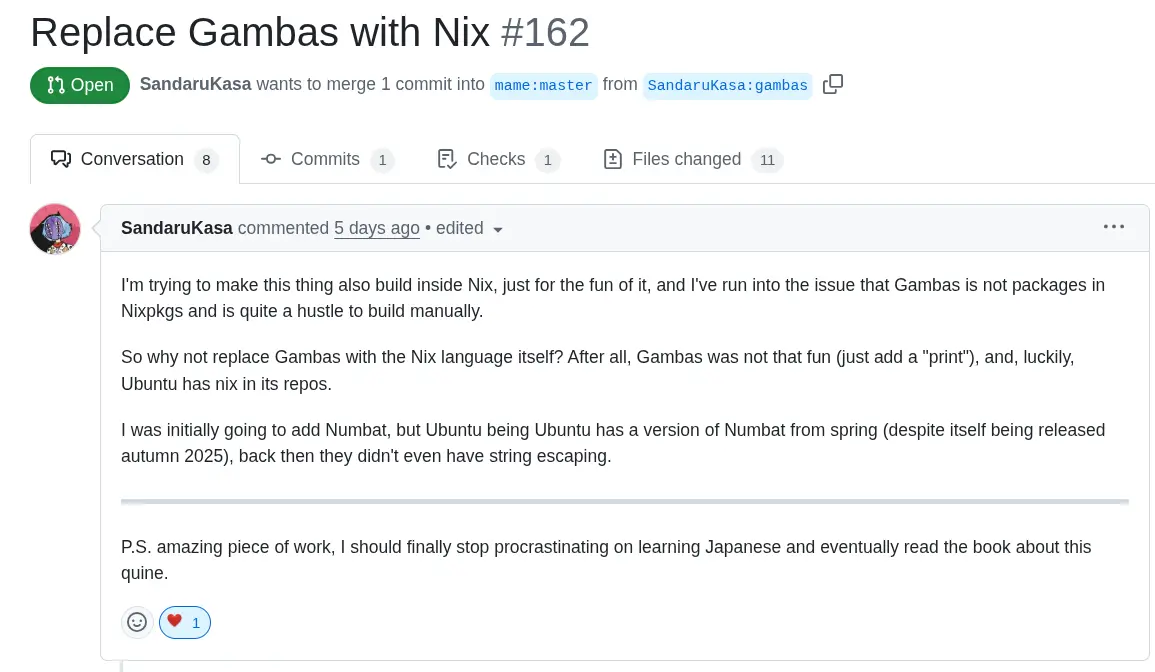
😲 🤯 !
@SandaruKasa had the exact same idea as me at basically the exact same time, and submitted their PR a few days before me!
I started taking a close look. Sandaru resolved many similar problems to me; often in a more elegant way. Both our approaches worked, and indeed we could both take interesting ideas from each others approach.
I was actually quite excited by this. First, I was very happy to learn from Sandaru, and have since refactored and improved my approach. Secondly, it also demonstrates the "ease" of packaging things with Nix: there was nothing unique that was required; merely dedication to getting it done. There wasn't only one magic solution to discover; it was possible to achieve the outcome in a variety of ways!
For me this is the best possible outcome.
So is that it? Is Nix amazingly perfect and should be immediately adopted for every programming language? Maybe.
But I will note that there is a world of difference between simply running a programming languages compiler or interpreter; and doing every-day incremeintal development and keep a maintainable Nix setup that works for everyone in your team. Some programming language ecosystems are better set up with Nix than others in this sense.
But the good news, is that all of this can be improved. And the benefits you get are huge!
You may recall this is how I got gambas working. Because it is not a requirement for an *nix operating-system to have /usr/lib/... - yet a lot of applications assume that it (and similar paths) will exist - this is a very convenient tool for wrapping those programs so that they can still execute.
overrideAttrs and overriding in general
Sandaru used this beautifully to bring in gm2 from the already-heavily-configured gcc package.
This quite trivially solved a very complex problem: How to build a very large and complex package? Luckily, in the case of such a popular package, as we've seen, there's a very good chance it's already in nixpkgs!
If something doesn't work, check another version on nixpkgs
Often, if something in whatever commit/branch of nixpkgs you've decided to use doesn't work, you may find it works in a more recent or older version.
This was true here for Swift.
Luckily, it's a very simple matter to just try a different version; by adding a new flake input: nixpkgs2505.url = "github:nixos/nixpkgs/nixos-25.05";. In this way you can try any commit you like!
Parallel builds
This is perhaps minor, but useful to remember: in your derivations you can set enableParallelBuilding which will then allow Nix to ... build whatever it can in parallel. Depending on your computer, this can wildly speed up your iteration process!
Patching is amazing ❤️
the mkDerivation function allows you to supply a list of patches (i.e. git diff ... outputs) that it can apply to the source tree. This is a very convenient strategy for quickly getting a build that works. In this particular process, it was important to be making progress; so my technique was to patch wildly, and then go back and refine the patch (in almost all cases entirely replace it with sed-style replacements) once the entire build was complete.
This is a nice incremental-kind of refactoring that keeps you productive and pragmatic, but allows room for precision when you need it.
Open source is amazing!
In fact, quite clearly, patching would be very hard if the code wasn't open-source. Even though I've worked as a programmer for over 25 years now, I still found myself amazed at how useful it was to be able to see and change the code to get it to work, even say 10 or 15 years after it was originally released. Amazing.
Monorepo's can be frustrating
Of course monorepos are controversial, and they can be both extremely pragmatic and productive. Myself personally I'm open-minded.
But, while hacking on this I noticed that, if you just want part of a monorepo, they can be extremely inconvenient; because, unless it's done extremely well, as an external consumer, you need to take into your head the whole structure of all the parts you don't care about; i.e. you need to work out what depends on what, and how to exclude the things you don't care about.
This, at least, was not an aspect of monorepo's that I had personally previously considered.
Why use stable nixpkgs?
One thing that occured to me recently is that, when working on many projects (or perhaps your company has 100s of repositories), it pays off big to use a stable input for nixpkgs; i.e. nixpkgs.url = "github:nixos/nixpkgs/nixos-25.11. This allows for the most re-use of build outputs between all your various projects.
Fixed-output derivations (FODs) can be useful
A typical Nix derivation cannot access the internet; this is because the goal is reproducibility, and any kind of internet access could result in a difference next time.
But what if you need to access the internet? To download a package? (or even just source code?! which we do all the time.)
The solution to this is simple and elegant: just declare the hash of the contents you are expecting to receive! Nix then permits the derivation to access the network, but will error out if the resulting hash doesn't match.
This is useful for package managers that don't allow you to disable checks to the internet; or for packaging steps that require downloading some dependencies.
My changes are easiest to browse here: silky/quine-relay/nix.
There you can find:
flake.nix entrypoint,pkgs.nix which has all the Nix derivations for the packages that weren't in nixpkgsoutputs.nix that has each step of the quine expressed as a simple call, ultimately, to mkDerivation ...If you prefer, you can just run it like so:
nix build github:silky/quine-relay/nixThen you will find all the source files in ./result.
Perhaps the most fun, at least for me personally, was to see what the resulting piet program looks like (check ./result/php-to-piet/share/QR.png.)
If you feel like playing around adding some new languages, take a look at this PR: Experiment with other languages; you just need to look at editing ./src/code-gen.rb and then run rake to generate QR.rb.
There's also a video based on this article: TechTalks #6 | Packaging 128 programming languages with Nix; note that it was presented to an audience unfamiliar with Nix; so a lot of time is spent on background.
I'd be very happy to help you on your Nix journey. If you're inspired, intrigued, stuck, or otherwise keen to make some progress, then please do get in contact :)